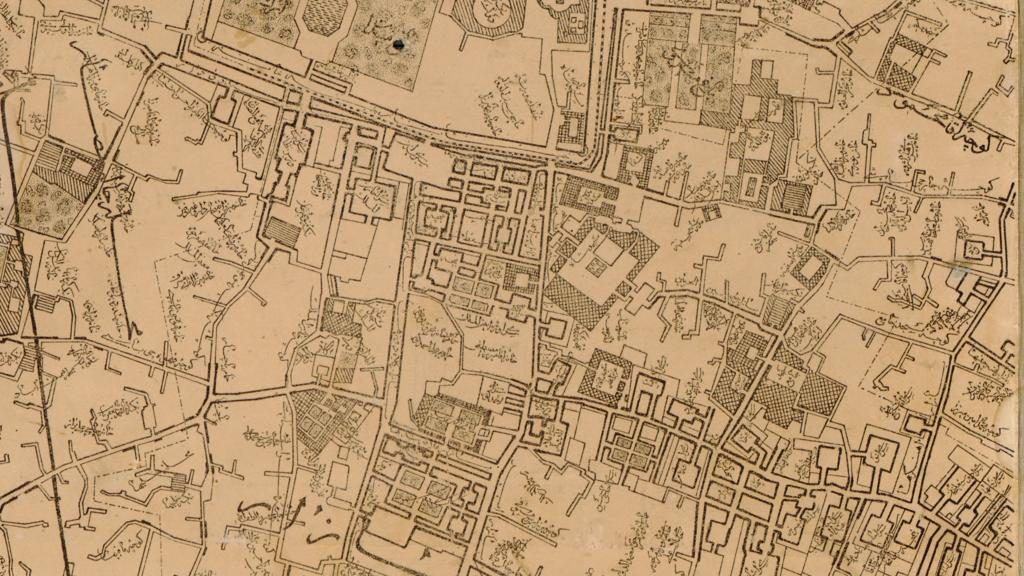
Did you have relatives living in Tehran or Mashhad in the 19th century? If so, you might be able to find your ancestors in the censuses of Tehran and Mashhad discussed here.
The censuses generally recorded the names of the heads of households in the city at a given time. Additionally, they put these names into the geographical context of their neighborhood. For these reasons, these censuses are invaluable genealogical resources. Unfortunately, they are not text-searchable. If you know of a Persian OCR service that can handle books of these size, please inform us via the Contact Form.
Tehran Censuses
Three Qajar-era (1789-1925) censuses from 1269 LH (1852/3), 1286 LH (1869/70), and 1317 LH (1899/1900) were transcribed in the book آمار دارالخلافه تهران, which is accesible on pdftarikhema.com.
The first census is from 1269 Hijri (1852/3). It recorded the number of houses, tekieh, shrines, mosques, schools, artillery centers, arsenals, warehouses, baths, and stables in Tehran. It categorized these establishments based on their neighborhood (Ark, Udlājān, Bāzār, Sangelaj, Chāl-e Meydān, and Tehran’s outlying areas) and specific location. Houses were also categorized based on the status of their owners (aristocracy, servants, clerics, citizens, Armenians, Jews, and Turkmen). Most importantly, it recorded the names of heads of households.
The second census is from 1286 LH (1869/70). It does not provide the names of any of Tehran’s residents. Instead, it merely summarizes statistics on Tehran’s population and establishments.
The third census is from 1317 LH (1899/1900). It recorded houses, shops, caravanserais, baths, mosques, schools, gardens and orchards, tekieh, ice houses, factories, barracks, churches, squares, clinics, synagogues, and stables in Tehran. The census categorized these establishments by their specific location (neighborhood, hangout, street). It also recorded the names of heads of households.
This third census is a uniquely helpful genealogical resource for four reasons: (1) it names the owners of these establishments; (2) it places the establishments in the context of what surrounded them, instead of categorizing them by social class like the earlier census; (3) it provides very specific neighborhood/street names; and (4) it predates the advent of civil registration in Iran by only 25 years, increasing the possibility of finding traceable ancestors in this census.
For another summary of these censuses see this abstract of the book.
Mashhad Census
A census of Mashhad was taken in 1295/6 LH (1878/9) by Zeinolabedin Mirza Qajar. It is transcribed in the book نفوس ارض اقدس یا مردم مشهد قدیم, which is accesible on eliteraturebook.com.
The census recorded the names, Imam Reza Shrine affiliation, citizenship status, occupations, and social status of heads of households in Mashhad. It also recorded the number of men, women, elderly, young, girls, boys, and infants. The census divides the data among Mashhad’s Sarāb, Sarshur, Eidgāh, Pa’inKhiābān, Noghān, and BālāKhiābān neighborhoods
Other Censuses
Iran held other censuses in 1884, 1892, 1922, 1932, 1933, 1940 (Qatar Digital Library). British Foreign Office memoranda on the 1933 and 1940 censuses (some of which contain statistics) can be found in the Qatar Digital Library.
The content and division of localities from 1922 census formed the basis for Jafar Shahribaf’s six-volume Tārikh-e ejtemā’i-ye Tehrān-e gharn-e sizdahom: zendegi, kasb, va kār (تاریخ اجتماعی تهران در قرن سیزدهم: زندگی، کسب و کار) (Ahmad Ashraf, Iranian Studies 26:3-4, Summer/Fall 1993). The book was apparently translated by Amin Neshati (Id.). The first volume contains sections from the 1884, 1892, 1922, 1932, and 1933 censuses (Archnet).
Iran has conducted nationwide censuses every ten years since 1956. The 1956-2016 censuses can be found on the Iran Data Portal.
Other censuses and statistical information can be found on the Statistical Centre of Iran’s website.
 Iranian Genealogy
Leave a comment